Sixty leaders, negotiators, mediators and diplomats. For each: what they actually did, in which processes, and in what role — led, negotiated, signed or mediated.
All names
Four Israeli prime ministers
Recognising a contribution to peace is not an endorsement of everything a leader did or believed. The order is chronological, not a ranking.
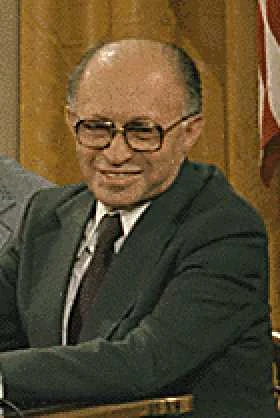
The prime minister who signed Israel's first peace treaty with an Arab state and, under it, returned Sinai to Egypt.
He became prime minister on 20 June 19771. In November 1977 he sent Egypt's President Anwar Sadat a formal invitation and hosted him in Jerusalem; in his reply in the Knesset he called for negotiations between equals, without preconditions – Sadat's visit to Jerusalem23.
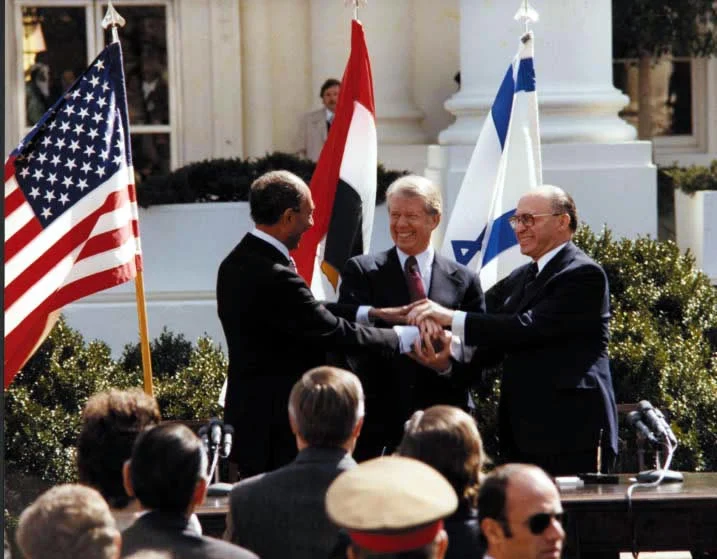
In September 1978 he negotiated with Sadat at Camp David, with President Jimmy Carter mediating, and on 17 September signed the two framework accords with him – the Camp David Accords4. The Knesset approved them on 28 September by 84 votes to 195.
On 26 March 1979 he signed the Egypt–Israel peace treaty with Sadat in Washington; Carter signed as witness6. Four days earlier the Knesset had approved the treaty by 95 votes to 187.
His government carried out the full withdrawal from Sinai required by the treaty, including the forced evacuation of the town of Yamit on 23 April 19828.
He received the 1978 Nobel Peace Prize jointly with Sadat9.
Context: Recognising his contribution to peace is not an endorsement of all his policies. Eighteen Knesset members voted against the peace treaty7. The autonomy framework for the Palestinians in the West Bank and Gaza Strip, which he signed at Camp David, stayed on paper4. In June 1982 he authorised the military operation in Lebanon10; the war lasted longer than promised, went beyond its original aims, caused hundreds of Israeli casualties and set off wide public protest11. On 28 August 1983 he announced his resignation10.
No more war, no more bloodshed, no more bereavement.
Menachem Begin · Signing ceremony of the Egypt–Israel peace treaty, the White House, Washington, 26 March 1979 Official US transcript (Public Papers of the Presidents), in English. These are the closing words of a longer sentence in Begin's remarks. The wording is singular – "war", not "wars". The translations are the site's own, not official texts. Quote source: The American Presidency Project, UC Santa Barbara (Public Papers of the Presidents)Role in the processes
1922–1995 · Prime Minister of Israel, 1974–1977 and 1992–1995; Chief of Staff, 1964–1968
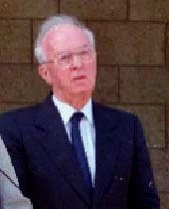
A soldier who, as prime minister, led the first agreements with the PLO and the peace treaty with Jordan, and was assassinated by an Israeli who opposed the process.
He was Chief of Staff in 1964–1968 and prime minister for the first time in 1974–19771. In that term the second disengagement agreement between Israel and Egypt was reached (September 1975), mediated by Henry Kissinger – the Sinai disengagement agreements (1974–75)2.
He received the 1994 Nobel Peace Prize jointly with Shimon Peres and Yasser Arafat10.
On 4 November 1995, at the end of a peace rally in Tel Aviv, he was shot dead by Yigal Amir, an Israeli who opposed the Oslo process11.
Context: Recognising his contribution to peace is not an endorsement of all his policies. The agreements he led with the PLO were interim agreements: they did not create a Palestinian state and left Jerusalem, refugees, settlements and borders to permanent-status talks4. Israel was deeply divided – the Interim Agreement passed the Knesset by only 61 votes to 5912. No agreement was reached with Syria, and what Rabin deposited with the Americans about the Golan Heights is disputed to this day13.
Yitzhak Rabin, soldier in the Israel Defense Forces, and a soldier in the army for peace
Yitzhak Rabin · US Congress, Washington, 26 July 1994. An excerpt from the sentence in which Rabin introduces himself by his military number. A short excerpt from the Rabin Center’s English transcript, not the full sentence. A Hebrew text is also available from the Center. Quote source: The Yitzhak Rabin CenterRole in the processes
1923–2016 · Foreign Minister, 1992–1995; Prime Minister, 1984–1986 and 1995–1996; President of Israel, 2007–2014
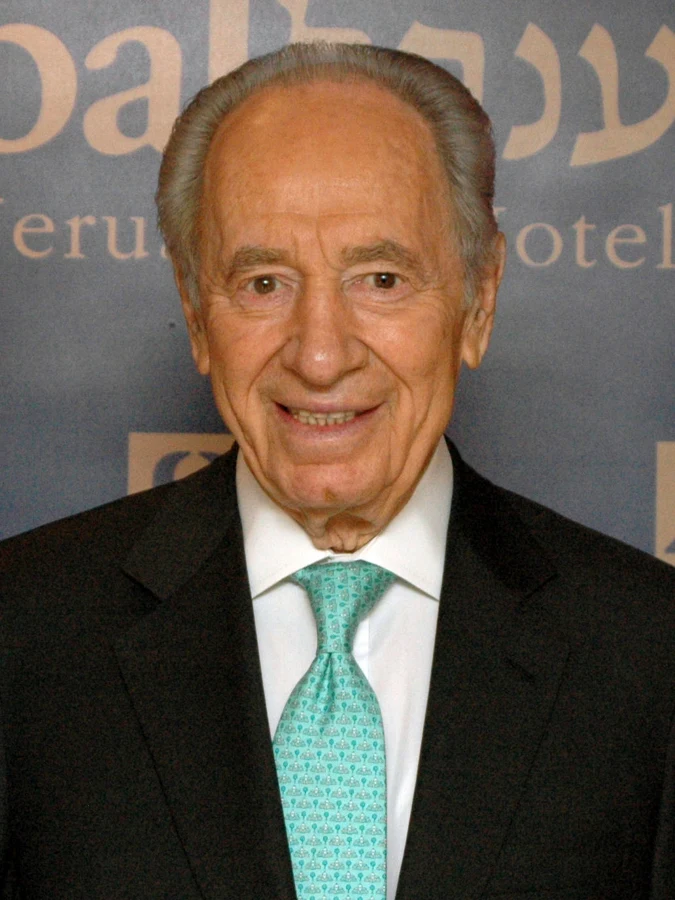
The statesman who advanced secret negotiating channels with Jordan and with the PLO, and signed the Declaration of Principles for Israel.
On 11 April 1987, as foreign minister, he reached an understanding in London with King Hussein on an international conference leading to direct talks – the London Agreement (1987). Prime Minister Yitzhak Shamir rejected it and it was never adopted1.
As foreign minister in Rabin's government he oversaw the secret channel in Oslo, opened with Norwegian facilitation2; the contacts for Israel were run by his ministry's director-general, Uri Savir3.
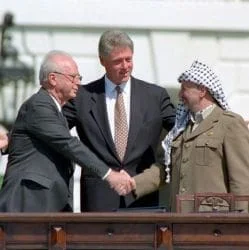
On 13 September 1993 he signed the Declaration of Principles (Oslo I) for Israel at the White House; Mahmoud Abbas signed for the PLO, and the witnesses were the foreign ministers of the United States and Russia4.
He received the 1994 Nobel Peace Prize jointly with Yitzhak Rabin and Yasser Arafat6.
Context: Recognising his contribution to peace is not an endorsement of all his policies. The London understanding failed because the prime minister in whose government he served rejected it1. The documents he signed in the Oslo process were interim agreements, and no permanent settlement followed them7. After Rabin's assassination he became prime minister, and lost the May 1996 election to Benjamin Netanyahu8.
There was a time when war was fought for lack of choice. Today it is peace that is the "no-choice" option.
Shimon Peres · Nobel Lecture, Oslo, December 1994 The English text published by the Nobel Foundation; two consecutive sentences. The lecture page shows no date; 10 December is the date of the prize ceremony. The site did not verify the language in which the lecture was delivered. The translations are the site's own, not official texts. Quote source: The Nobel Prize (Nobel Foundation)Role in the processes
1949– · Prime Minister of Israel, 1996–1999, 2009–2021 and since 2022
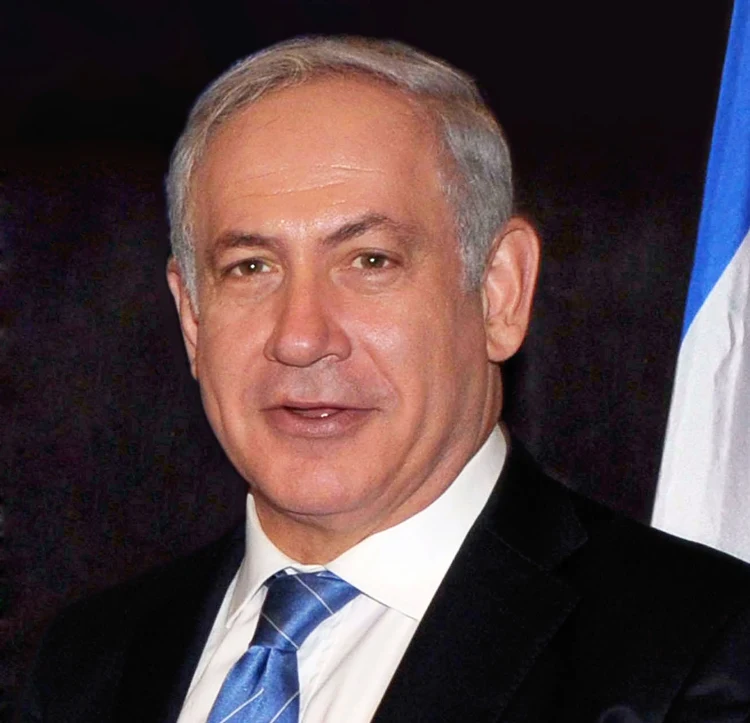
The prime minister who signed the Abraham Accords, which established formal relations between Israel and the United Arab Emirates, Bahrain and Morocco.
On 13 August 2020 he issued, with President Donald Trump and Abu Dhabi's Crown Prince Mohamed bin Zayed, a joint statement announcing full normalization between Israel and the UAE1.
During his term the Joint Declaration with Morocco was signed in Rabat on 22 December 2020; in it Israel and Morocco undertook to resume official contacts and reopen their liaison offices5.
On 23 October 1998 he signed the Wye River Memorandum with Yasser Arafat, in the presence of President Clinton; it provided for 13% of the West Bank to be transferred in stages from Area C to Areas A and B78.
In his 14 June 2009 Bar-Ilan speech, he expressed willingness to accept a future demilitarised Palestinian state beside the Jewish state, conditional on recognition of Israel as the Jewish people’s state and security guarantees. This records his position in that speech, not a signed agreement or his current policy.9
Context: Recognising his contribution to peace is not an endorsement of all his policies. In the August 2020 statement Israel agreed to suspend – not cancel – applying sovereignty to areas of the West Bank1. The Wye River Memorandum was only partly implemented, and his coalition collapsed8. The Kerry talks (2013–14) ended without an agreement, each side blaming the other10; as of October 2026 no permanent-status negotiations with the Palestinians are under way11. In July 2024 the Knesset, with the support of his coalition, passed a resolution against the establishment of a Palestinian state by 68 votes to 912, and on 11 September 2025 he declared at Ma'ale Adumim that there would be no Palestinian state13.
Ladies and gentlemen, Mr. President, this day is a pivot of history. It heralds a new dawn of peace.
Benjamin Netanyahu · Abraham Accords signing ceremony, South Lawn of the White House, 15 September 2020 Official White House transcript, in English. The Hebrew and Arabic translations are the site's own, not official texts. Quote source: The White House (Trump White House archive, US National Archives)Role in the processes
1915–2012 · Prime Minister of Israel, 1983–1984 and 1986–1992
The prime minister who headed the Israeli delegation to the Madrid Conference, where direct talks between Israel and its neighbours began.
He was prime minister in 1983–1984 and 1986–19921. In October 1991 he headed the Israeli delegation to the Madrid Conference, where all the parties sat down to direct talks for the first time2.
Context: In 1987 he rejected the understanding that Shimon Peres and King Hussein had reached in London3. The bilateral talks that began after Madrid had stalled by 19932.
The prime minister who tried to reach a permanent settlement with the Palestinians and an agreement with Syria within a short time – and reached an agreement on neither track.
In July 2000 he negotiated with Arafat at the Camp David summit (2000), hosted by President Clinton. The summit ended without an agreement, and with a trilateral statement on continuing the negotiations3.
In January 2000 he held talks in the United States with Syria's Foreign Minister Farouk al-Sharaa; these too ended without an agreement – the talks with Syria (1991–2008)4.
Context: Responsibility for the failure of Camp David is disputed among the participants themselves56.
The prime minister who removed every settlement in the Gaza Strip – as a unilateral step, not under an agreement.
He was prime minister in 2001–20061. In 2003 his government accepted the Roadmap with 14 reservations2.
On 18 December 2003 he announced the Gaza disengagement. In August 2005 all 21 settlements in the Gaza Strip and four in the northern West Bank were evacuated, and the last soldiers left the Strip on 12 September 20053.
Context: The disengagement was not an agreement: Israel kept control of the Strip's airspace, territorial waters and land perimeter3. The Second Intifada broke out at the end of September 2000, after his visit to the Temple Mount / Haram al-Sharif4.
The prime minister who in 2008 showed Mahmoud Abbas a map for a permanent settlement, and returned in 2024 with a joint proposal with a former Palestinian foreign minister.
In September 2008 he showed Abbas a map: withdrawal from about 94% of the West Bank, land swaps of about 6%, a passage between Gaza and the West Bank, and a special arrangement in Jerusalem3.
Context: The 2008 talks ended without an agreement, and the accounts differ: Olmert says Abbas never replied; Abbas has said he was shown the map but not given it3. The 2024 proposal is unofficial: neither man holds government office today.
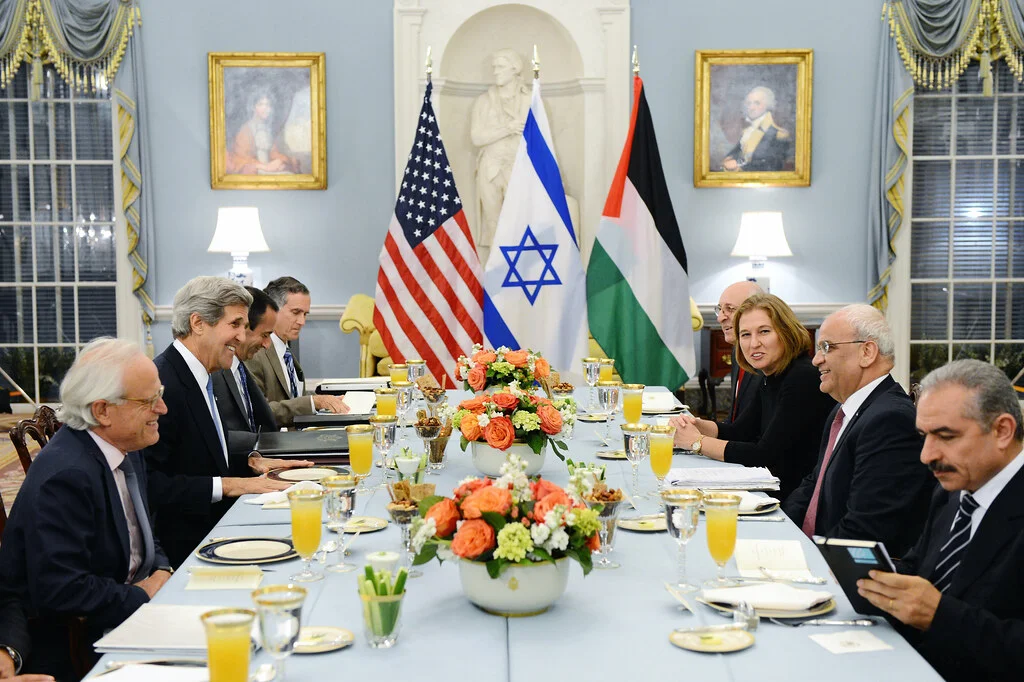
In 2013–14, as justice minister, she led the negotiations with Yitzhak Molcho, opposite Saeb Erekat and Mohammad Shtayyeh – the Kerry talks (2013–14)3.
Context: None of these initiatives was adopted by an Israeli government or a Palestinian leadership3. The confederation idea has drawn criticism, including over the friction that could arise if settlers remained inside the Palestinian state5.
Historian at the University of Haifa; one of the openers of the secret Oslo channel
An academic who, with no official standing, opened the secret channel of talks with the PLO.
Together with Ron Pundak he opened a secret channel of talks with PLO representatives that eventually led to the Declaration of Principles (Oslo I)1. The talks were held in Norway, with Norwegian help2.
The Wilson Center describes him as a key architect of the Oslo Accords; he later headed the Economic Cooperation Foundation (ECF)3.
Director-general of the Foreign Ministry from 1993; Israel's chief negotiator with the Palestinians in the Oslo process
The diplomat who ran Israel's negotiations with the PLO in the Oslo process.
As director-general of the Foreign Ministry he was Israel's chief negotiator with the Palestinians in the Oslo process – the Declaration of Principles (Oslo I)1.
He also took part in the Israeli delegations that negotiated with Jordan, leading to the Israel–Jordan peace treaty, and with Syria (1995–96)1.
Legal adviser to the Israeli delegation in Oslo; then Legal Adviser of the Foreign Ministry
The lawyer who drafted the Oslo agreements for Israel.
By his own account, he joined the talks in May 1993 at Rabin's request, to review and repair the draft of the Declaration of Principles (Oslo I), and spent about four months negotiating with PLO representatives1.
In 1993–94 he chaired the Israeli delegation to the negotiations with Jordan, which drafted the Israel–Jordan peace treaty1; on 14 September 1993 he signed the Common Agenda for the talks with Fayez Tarawneh2.
1934– · Deputy head of the Mossad, 1990–1995; head of the Mossad, 1998–2002
The Mossad officer who served as a secret emissary between Rabin and King Hussein on the way to the peace treaty with Jordan.
As deputy head of the Mossad he was Rabin's emissary in the secret contacts with King Hussein that led to the Israel–Jordan peace treaty1. The Israel State Archives describe him and Crown Prince Hassan as key channels in the negotiations2.
1945– · Commander of the Navy, 1992–1996; head of the Shin Bet, 1996–2000
A former Shin Bet chief who, with a Palestinian intellectual, drafted a civil statement of principles for two states.
He served as commander of the Navy (1992–1996) and head of the Shin Bet (1996–2000)1. With Sari Nusseibeh he drafted the People's Voice (Ayalon–Nusseibeh): six principles, including two states for two peoples, borders based on the 1967 lines with equal land swaps, Jerusalem as an open city and capital of both states, refugees returning only to the Palestinian state, a demilitarised Palestinian state, and an end to the conflict23.
Context: This is a civil initiative, not an official document of the parties. Sources differ on its date: 2002 or 200332.
1918–1981 · President of Egypt until his assassination in 1981
The Egyptian president who travelled to Jerusalem, addressed the Knesset and signed the first peace treaty between an Arab state and Israel.
On 9 November 1977 he told Egypt's parliament he was ready to go to the Knesset; on 19 November he landed in Israel, and the next day he addressed the Knesset – Sadat's visit to Jerusalem1. In his speech he demanded an end to the occupation of the territories taken in 1967 and self-determination for the Palestinians, and accepted Israel as a neighbour in a lasting and just peace2.
He received the 1978 Nobel Peace Prize jointly with Begin5.
Context: The price was heavy. The Arab League suspended Egypt's membership and moved its headquarters from Cairo to Tunis6. On 6 October 1981 he was assassinated at a military parade in Cairo by an Islamist cell; the assassins had several documented motives – peace with Israel was one of them, alongside religious demands and a wave of arrests of opponents of the government7.
Sadat's successor, under whom implementation of the peace treaty was completed and Egypt hosted stages of the Israeli–Palestinian process.
He became president after Sadat's assassination and served in 1981–20111. Under him implementation of the Egypt–Israel peace treaty was completed: Israel finished its withdrawal from Sinai in April 198223, and Taba was returned to Egypt on 15 March 1989 after arbitration4.
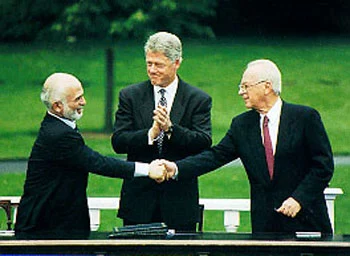
Hussein, Clinton and Rabin in Washington, 25 July 1994, ahead of the October peace treaty · White House
King Hussein of Jordan
1935–1999 · King of Jordan, 1953–1999
The king who ended the state of belligerency with Israel and led Jordan to a full peace treaty.
He reigned in Jordan in 1953–19991. On 11 April 1987 he reached an understanding in London with Foreign Minister Shimon Peres on an international conference – the London Agreement (1987); Israel's prime minister rejected it2.
He met Yitzhak Rabin in secret in Aqaba and London3, and on 25 July 1994 signed the Washington Declaration with him at the White House, ending the state of belligerency between the two countries4.
Context: In October 1998, while being treated for cancer in the United States, he came to the Wye River talks to help bring about an agreement between Israel and the Palestinians7, and spoke at the signing ceremony on 23 October8. In Jordan too there was opposition to the peace treaty: 23 deputies voted against it6.
In October 2018 he gave notice ending the special regime at Naharayim/Baqura and Tzofar/Al-Ghamr, as the Israel–Jordan peace treaty allows; the arrangement expired on 10 November 20193.
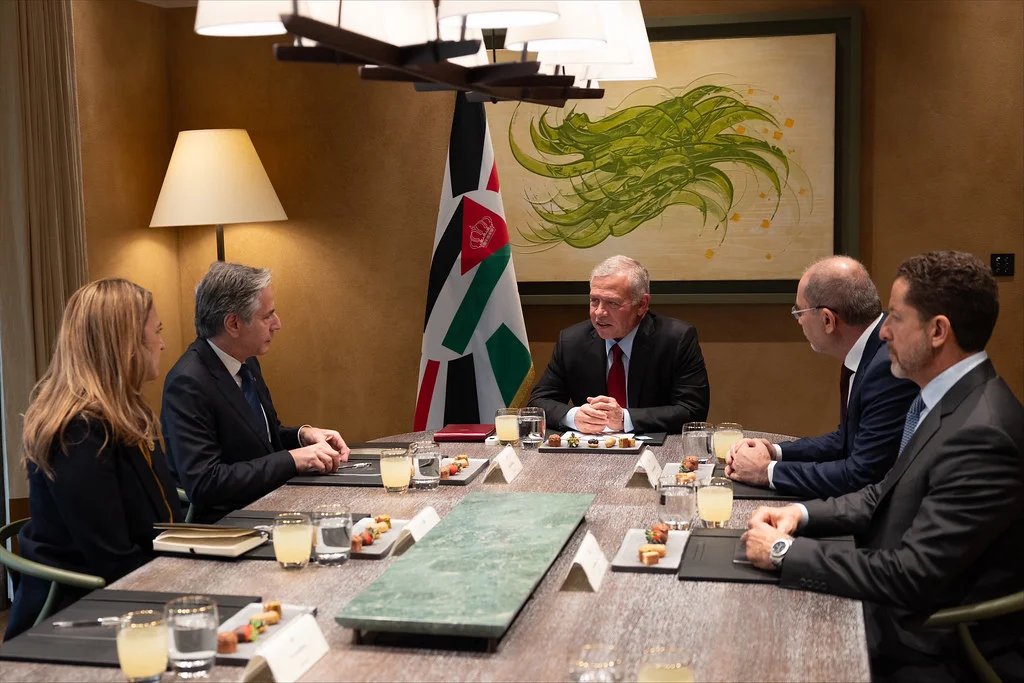
Context: As of October 2026 the peace treaty is in force, but political relations are at a low point: Jordan recalled its ambassador in November 2023, and in July 2026 a royal decree ended his mission without naming a successor45.
1929–2004 · Chairman of the PLO; President of the Palestinian Authority, 1996–2004
The PLO leader who recognised Israel's right to exist and signed the interim agreements with it.
On 9 September 1993 he signed a letter to Yitzhak Rabin in which the PLO recognised Israel's right to exist in peace and security, accepted Security Council Resolutions 242 and 338, and renounced terrorism and violence – the letters of mutual recognition1.
Context:the Camp David summit (2000) ended without an agreement, and who was responsible is disputed: Dennis Ross, a leader of the US team, placed the main responsibility on Arafat6; Robert Malley and Hussein Agha argued that all three parties erred7. The interim agreements never matured into a permanent settlement8.
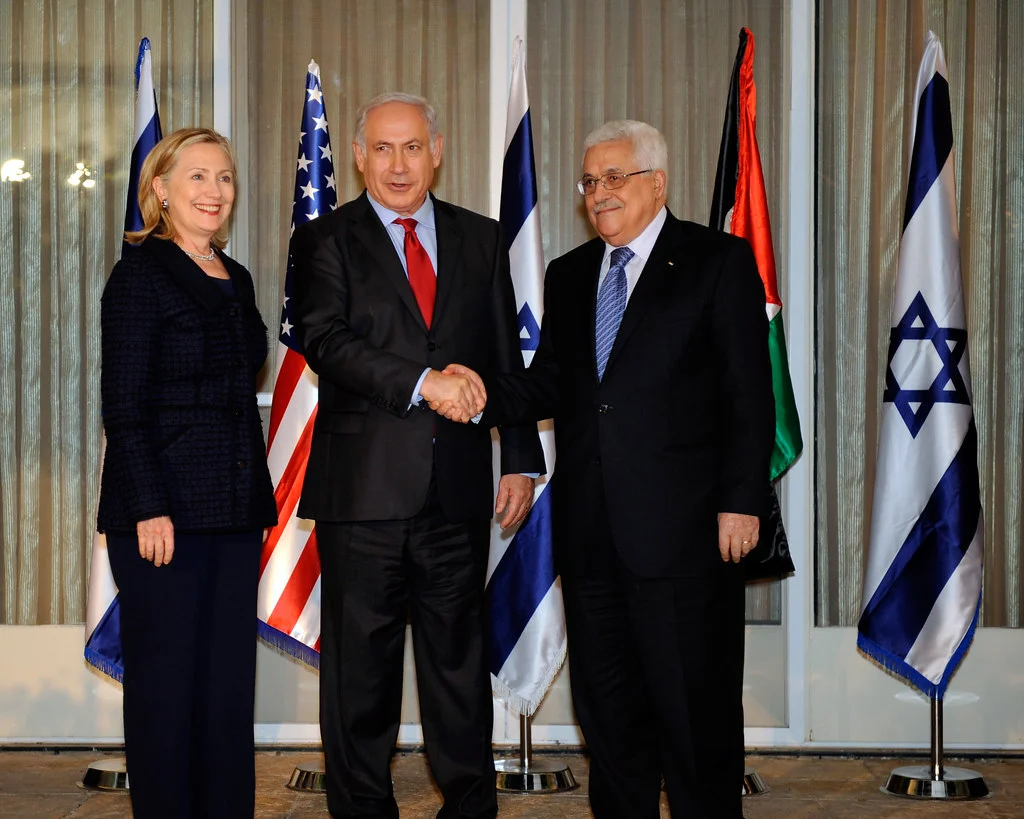
Netanyahu and Abbas shake hands at the Prime Minister's Residence in Jerusalem as Secretary of State Hillary Clinton looks on, September 2010 · State Department photo / Public Domain
Mahmoud Abbas
1935– · Signed the Declaration of Principles for the PLO (1993); Prime Minister of the Palestinian Authority in 2003; President of the Authority since 2005
He signed the Declaration of Principles for the PLO, and since 2005 has led the Palestinian side in the rounds of negotiation with Israel.
Context: None of the rounds ended in an agreement. On the 2008 talks the accounts differ: Olmert says Abbas never replied to his offer; Abbas has said he was shown the map but not given it3. He rejected the Trump plan (2020) outright5. Since June 2007 Hamas has controlled the Gaza Strip and the Authority he heads parts of the West Bank6; Encyclopaedia Britannica describes his presidency as a period of deep factional division and a stalled peace process7.
1937–2023 · Head of the PLO's negotiating team in Oslo; Speaker of the Legislative Council, 1996–2006; Prime Minister of the Authority, 2003–2004 and 2005–2006
The PLO official who ran the secret negotiations in Oslo and signed the economic agreement with Israel.
1946– · Official spokesperson of the Palestinian delegation to the peace talks after Madrid; member of the PLO Executive Committee, 2009–2020
An academic who was the voice of the Palestinian delegation in the peace talks of the early 1990s.
Ahead of the Madrid Conference she was a member of the Palestinian delegation that met US Secretary of State James Baker; after the conference she served as official spokesperson of the Palestinian delegation in the Washington talks and as a member of its steering committee1.
In 1996 she was elected to the Palestinian Legislative Council for Jerusalem, and served as minister of higher education until she resigned in 1998; she founded the civil-society organisation MIFTAH1.
Context: At Madrid the Palestinians took part within a joint Jordanian–Palestinian delegation, and the PLO had no formal seat2.
1944– · PLO official and former Palestinian Authority minister; one of the leaders of the Geneva Initiative
The Palestinian politician who, with Yossi Beilin, led an unofficial and detailed text of a permanent agreement.
With Yossi Beilin he led the Geneva Initiative, unveiled in Geneva on 1 December 2003: two states based on the 1967 lines with equal land swaps, Jerusalem as the capital of both, and an agreed solution to the refugee question12.
Context: The initiative is unofficial, and neither leadership adopted it2.
A Palestinian philosopher who, with a former Shin Bet chief, drafted a civil statement of principles for two states.
He was president of Al-Quds University in 1995–20141. With Ami Ayalon he drafted the People's Voice (Ayalon–Nusseibeh): six principles, including two states for two peoples, borders based on the 1967 lines with equal land swaps, Jerusalem as an open city and capital of both states, and refugees returning only to the Palestinian state23.
Context: This is a civil initiative, not an official document of the parties. Sources differ on its date: 2002 or 200332.
Lawyer; legal adviser to the Palestinian negotiations, 1994–2008
A Palestinian lawyer who accompanied the negotiations with Israel and, with Yossi Beilin, drafted a proposal for a confederation of two states.
She chaired the legal committee for the permanent-status negotiations and served as legal adviser to the peace talks in 1994–20081.
In 2022, with Yossi Beilin, she published the "Holy Land Confederation" proposal: two independent states within a confederal framework – the confederation model2.
Context: The proposal is unofficial and has drawn criticism – including over the friction that could arise if settlers remained inside the Palestinian state, and over how fragile confederations are3.
1953– · Representative of the PLO and Palestine at the United Nations, 1991–2005; Foreign Minister of the Palestinian Authority, 2005–2006
A veteran Palestinian diplomat who in 2024, with a former Israeli prime minister, published a joint proposal for two states.
He represented the PLO and Palestine at the United Nations in 1991–2005 and was foreign minister of the Palestinian Authority in 2005–20061.
On 17 July 2024 he signed the Olmert–al-Kidwa proposal (2024) with Ehud Olmert: two states based on the 1967 lines with a 4.4% land swap, Jerusalem as two capitals, and a five-state trusteeship for the Old City2. The two presented the proposal to Pope Francis on 17 October 20243.
Context: The proposal is unofficial. In March 2021 al-Kidwa was dismissed from Fatah's Central Committee1.
~1923–2015 · Saudi Crown Prince in 2002; King of Saudi Arabia, 2005–2015
The Saudi crown prince who proposed the Arab Peace Initiative.
He proposed the Arab Peace Initiative, adopted at the Arab League summit in Beirut on 27–28 March 2002: full Israeli withdrawal from the territories occupied in 1967, a just and agreed solution to the refugee question, and a Palestinian state with East Jerusalem as its capital – in return for an end to the conflict, peace agreements and normal relations between the Arab states and Israel1.
Context: He became king of Saudi Arabia in 2005 and reigned until his death in 20152. No Israeli government has formally accepted the initiative3.
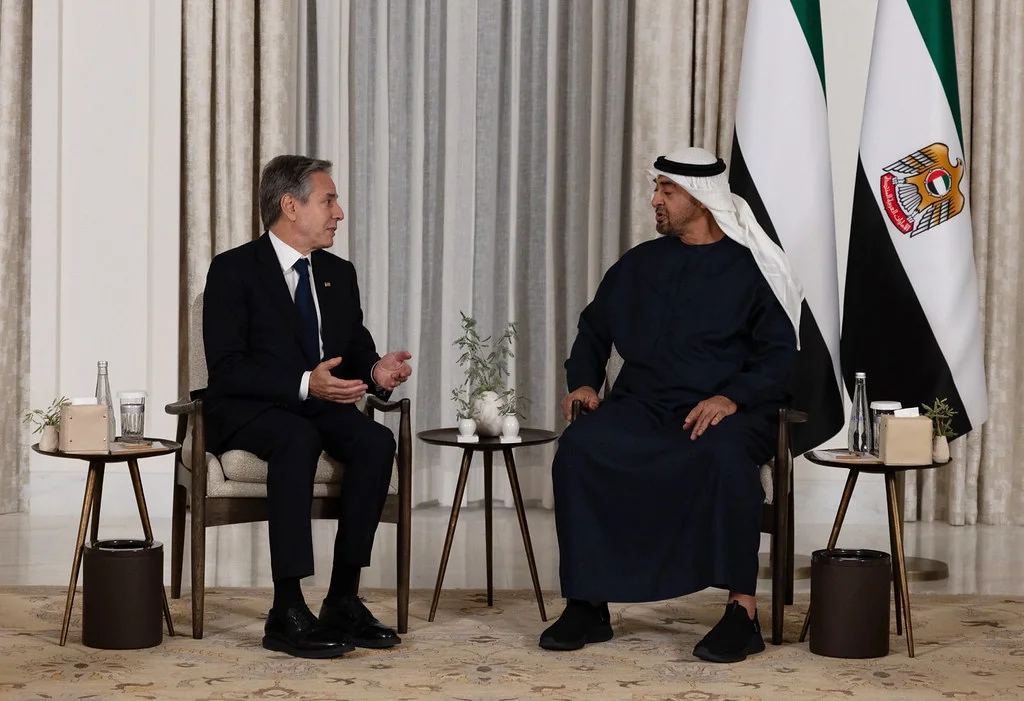
Crown Prince of Abu Dhabi at the time of the agreement (2020); now President of the United Arab Emirates
The Emirati leader who decided on full normalization with Israel.
On 13 August 2020 he issued, with President Trump and Benjamin Netanyahu, a joint statement announcing full normalization between the UAE and Israel; in the same statement Israel agreed to suspend applying sovereignty to areas of the West Bank1.
Context: The move departed from the sequence set by the Arab Peace Initiative, under which normal relations with Israel would follow withdrawal and the creation of a Palestinian state3.
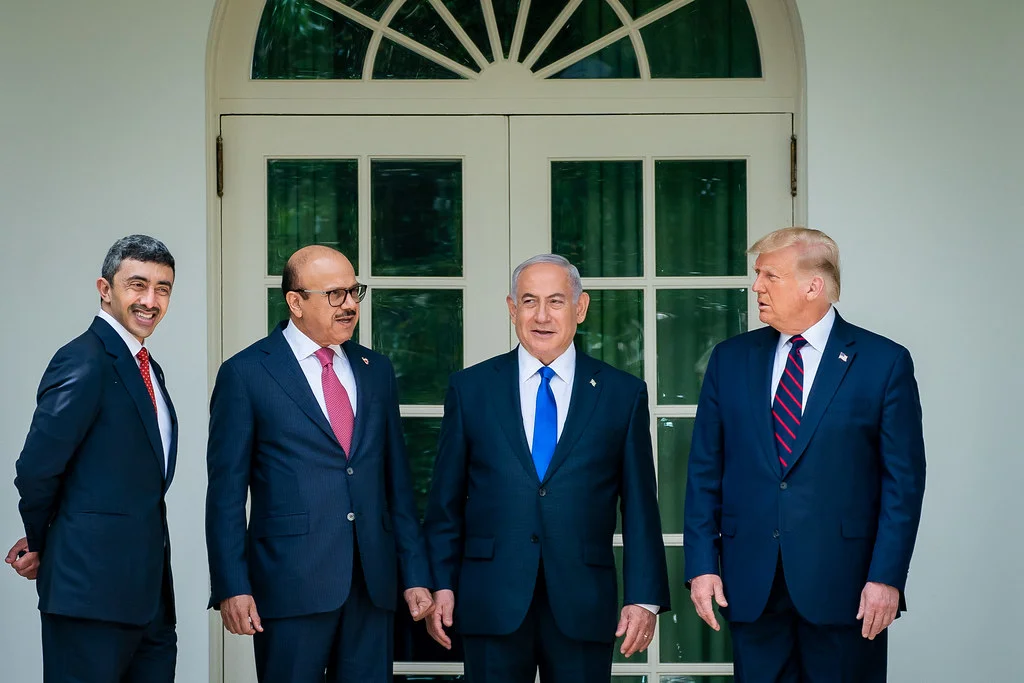
Trump walks along the White House Colonnade with Al Zayani, Netanyahu and Abdullah bin Zayed on the way to the signing ceremony · Official White House Photo by Tia Dufour
Abdullah bin Zayed Al Nahyan
1972– · Foreign Minister of the United Arab Emirates since 2006
The foreign minister who signed the treaty with Israel for the UAE.
He has been foreign minister since 9 February 2006; according to his official biography, he led the talks on the agreement and on establishing diplomatic relations with Israel1.
The king under whose leadership Bahrain established formal relations with Israel.
He led Bahrain's decision to establish relations with Israel politically, but did not sign himself1: the declaration with Bahrain was signed at the White House on 15 September 2020 by Foreign Minister Abdullatif Al Zayani2.
Context: The document signed in Washington is a declaration with no ratification clause – not a full peace treaty2.
Trump walks along the White House Colonnade with Al Zayani, Netanyahu and Abdullah bin Zayed on the way to the signing ceremony · Official White House Photo by Tia Dufour
Abdullatif Al Zayani
Foreign Minister of Bahrain at the time of the signing (2020)
The foreign minister who signed the declaration with Israel for Bahrain.
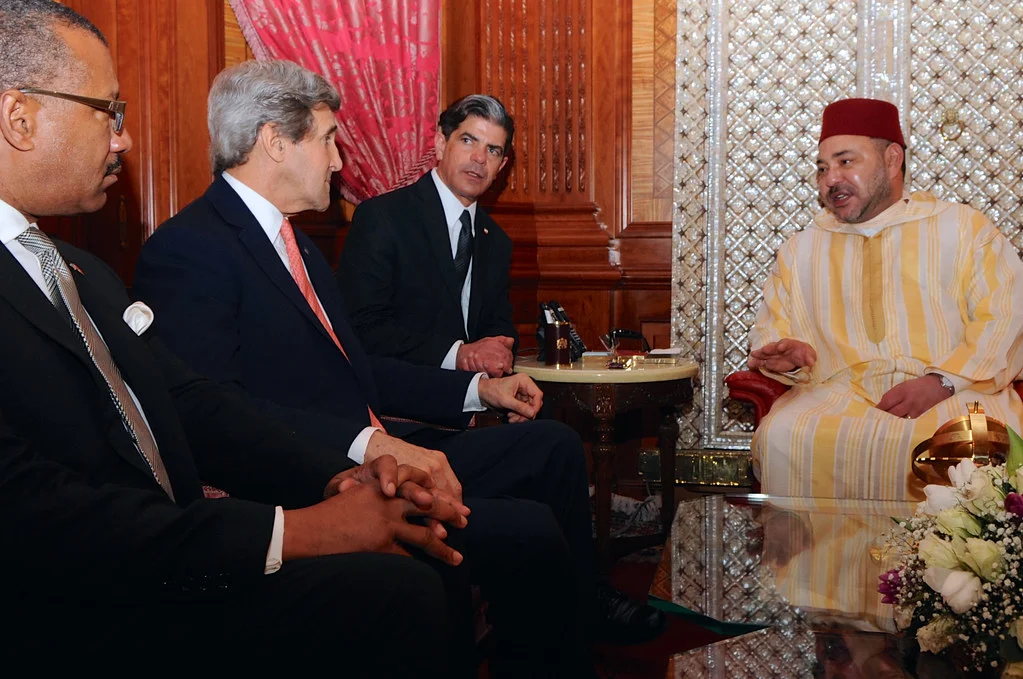
The king who decided in 2020 to resume formal relations between Morocco and Israel.
He came to the throne on 23 July 19991. Under his leadership the Joint Declaration with Morocco was signed in Rabat on 22 December 2020: Morocco and Israel undertook to resume full official contacts, reopen the liaison offices in Rabat and Tel Aviv, and allow direct flights2.
Context: The declaration recalls US recognition of Moroccan sovereignty over Western Sahara – a separate step by the United States, not an obligation between Israel and Morocco2. It is a joint declaration, not a peace treaty.
Sudan's military leader, under whom the country joined the Abraham Accords Declaration – without any agreement being signed with Israel.
Under his leadership Sudan signed the Abraham Accords Declaration in Khartoum on 6 January 2021; Justice Minister Nasredeen Abdulbari signed for Sudan, alongside US Treasury Secretary Steven Mnuchin – the Sudan track1.
On 2 February 2023 he met Israel's Foreign Minister Eli Cohen in Khartoum, and Sudan's foreign ministry said the sides had agreed to move forward towards normalization2.
Context: No bilateral agreement between Israel and Sudan was ever signed, and no embassies were opened3. Since war broke out in Sudan in April 2023 the track has been frozen; according to a Washington Institute analysis, both warring sides use normalization to gain legitimacy4.
1924–2024 · President of the United States, 1977–1981
The US president who mediated between Begin and Sadat, at Camp David and through to the signing of the peace treaty.
He hosted and mediated the Camp David summit, 5–17 September 1978, and signed the Camp David Accords as witness12.
In March 1979 he travelled to Israel and Egypt himself to bridge the last disagreements3, and on 26 March signed the Egypt–Israel peace treaty as witness4.
He received the 2002 Nobel Peace Prize for decades of effort to find peaceful solutions to international conflicts5.
Context: A dispute remained between him and Begin over the commitments on settlements, which were dealt with in the letters accompanying the Camp David Accords2.
Context: Camp David ended without an agreement; both sides accepted the parameters with reservations7. His meeting with Syria's President Hafez al-Assad in Geneva on 26 March 2000 did not bridge the gaps either8.
1924–2018 · President of the United States, 1989–1993
The US president who, after the Gulf War, convened the Madrid Conference.
He was president in 1989–19931. The United States and the Soviet Union sponsored the Madrid Conference, which opened on 30 October 1991, and he co-chaired it with Mikhail Gorbachev2.
Context: The conference opened direct talks but did not end in an agreement2.
The US president under whom the Roadmap was published and the Annapolis Conference was convened.
He was president in 2001–20091. Under him the Quartet – the United States, the European Union, Russia and the UN – published the Roadmap on 30 April 20032.
Trump walks along the White House Colonnade with Al Zayani, Netanyahu and Abdullah bin Zayed on the way to the signing ceremony · Official White House Photo by Tia Dufour
Donald Trump
1946– · President of the United States, 2017–2021 and since 2025
The US president under whose auspices the Abraham Accords were signed, and who in 2025 presented the plan that led to the Gaza ceasefire.
He was president in 2017–2021 and returned to office in 20251. On 13 August 2020 he issued the joint statement with Netanyahu and Mohamed bin Zayed2; on 15 September 2020 he hosted the signing ceremony, signed the Declaration of the Abraham Accords and witnessed the documents with the UAE and Bahrain34.
On 28 January 2020 he presented the Trump plan (2020) for the Israeli–Palestinian conflict5.
In 2025 he presented a 20-point plan to end the war in Gaza; the ceasefire took effect on 10 October 2025 – the Gaza ceasefire (2025)6, and the Security Council endorsed the plan in Resolution 28037.
Context: The 2020 plan was drawn up without Palestinian participation, and Mahmoud Abbas rejected it5. The Gaza plan is a ceasefire and a phased framework, not a peace agreement; as of October 2026 its second phase is stalled8.
1981– · Senior Advisor to President Trump, 2017–2021
The US adviser who played a central part for the White House on the way to the Abraham Accords.
He served as senior advisor to President Trump and played a central part in the administration's diplomatic initiatives in the Middle East, among them the Abraham Accords1.
Context: Alongside praise for his work, Encyclopaedia Britannica notes recurring questions about conflicts of interest arising from his business dealings with foreign governments1.
The secretary of state who prepared the Madrid Conference through rounds of shuttle diplomacy.
He was secretary of state from January 1989 to August 19921. After the Gulf War he conducted shuttle diplomacy between the region's capitals that prepared the ground for the Madrid Conference2.
The secretary of state who mediated the disengagement agreements after the 1973 war.
Through shuttle diplomacy between the capitals he brought about a disengagement agreement between Israel and Egypt in January 1974 and a second one between them in September 1975 – the Sinai disengagement agreements (1974–75)12.
Context: These are disengagement agreements, not peace agreements; the agreement with Syria says explicitly that it is not a peace agreement but a step towards a just and durable peace3.
The secretary of state who took part for the United States in the negotiations on the peace treaty between Israel and Egypt.
He was secretary of state from January 1977 to April 1980; the State Department's official history counts the Israel–Egypt peace treaty among his major achievements1.
His talks with Foreign Minister Moshe Dayan in March 1979, during President Carter's visit to the region, helped produce the final breakthrough before the signing of the Egypt–Israel peace treaty2.
The secretary of state who signed the Declaration of Principles as a witness and accompanied the Palestinian and Jordanian tracks.
He was secretary of state from January 1993 to January 19971. On 13 September 1993 he signed the Declaration of Principles (Oslo I) as a witness, together with Russia's Foreign Minister Andrei Kozyrev2.
According to the State Department's official history, he encouraged Israel, the Palestinians and Jordan to reach agreements, which led to the Oslo Accords and to the Israel–Jordan peace treaty1.
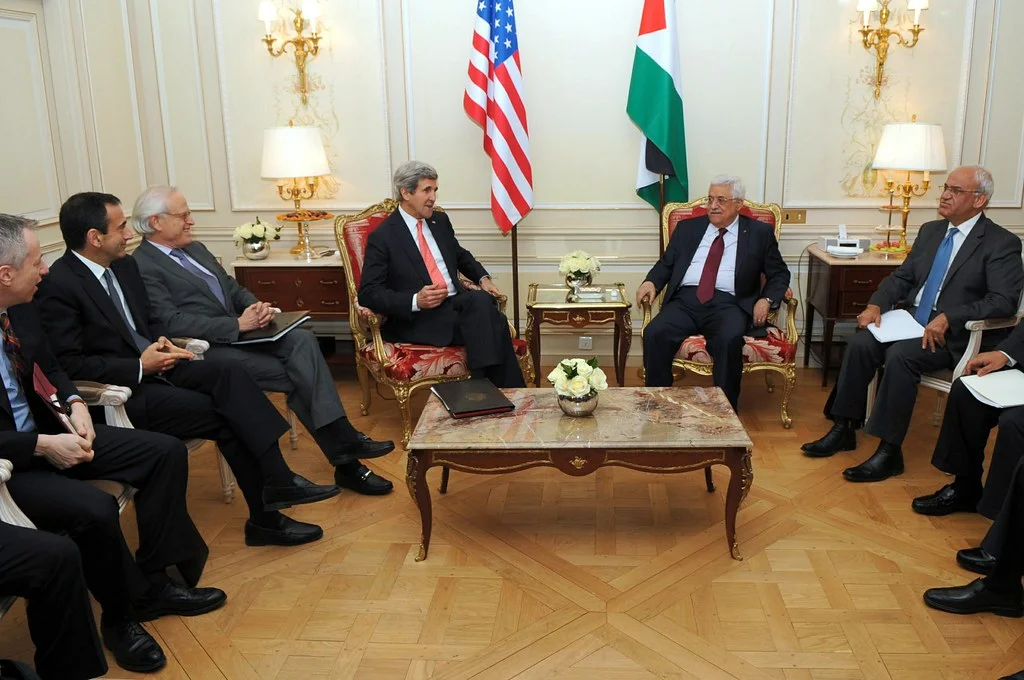
The secretary of state who initiated and led the most recent round of direct talks so far between Israel and the Palestinians.
He was secretary of state in 2013–20171. He initiated and led the Kerry talks (2013–14), which opened in July 2013 and were meant to last nine months, with the help of envoy Martin Indyk2.
Context: The talks ended in April 2014 without an agreement. Israel blamed unilateral Palestinian steps and the Fatah–Hamas reconciliation deal; the Palestinians blamed settlement expansion and the failure to release the fourth group of prisoners2.
According to his biography, he was the lead US negotiator in securing the ceasefire between Israel and Lebanon2 – the cessation of hostilities in Lebanon (2024), announced by the United States and France in November 20243.
Context: Neither arrangement is a peace agreement: one delimits a maritime boundary only, and the other is an arrangement to stop hostilities13.
The American diplomat who mediated, for the United Nations, the armistice agreements that ended the 1948 war.
After the mediator Folke Bernadotte was assassinated by Jewish extremists in 1948, he took over the task, and the following year, after tough negotiations, brought about an end to the fighting between Israel and its neighbours – the 1949 armistice agreements1.
He received the 1950 Nobel Peace Prize for his work as mediator in 1948–19491.
Context: These are armistice agreements, not peace agreements; the agreement with Egypt says explicitly that the armistice line is not a political or territorial boundary2.
1951– · EU Special Representative for the Middle East Peace Process, 1996–2003
The Spanish diplomat who recorded the Taba talks – the only detailed record of them.
He was the EU's Special Representative for the peace process in 1996–20031. In that role he wrote the unofficial paper summarising the Taba talks of January 2001: the two sides' positions on borders, Jerusalem, refugees and security2.
Context: The paper is not an agreed text and not an agreement: it is an unofficial European summary of talks that ended without an agreement2.
Arafat's letter of 9 September 1993, in which the PLO undertook to call on Palestinians to reject violence, was addressed to him – one of the three the letters of mutual recognition2.
1959– · Norwegian diplomat; member of the team that hosted the Oslo channel; later Norway's ambassador to the United Nations
The Norwegian diplomat who was part of the small team that made the secret talks between Israel and the PLO possible.
She was a member of the small Norwegian team that facilitated the secret negotiations between Israel and the PLO leading to the Declaration of Principles (Oslo I); at the time she worked in the foreign minister's office12.
In 1994–1997 she served at Norway's embassy in Tel Aviv and worked with both sides on implementing the agreements; in 1997–2000 she was Middle East coordinator and chaired the liaison committee of donors to the Palestinians1.
Director of the Norwegian research institute Fafo; UN Special Coordinator for the Middle East Peace Process, 1999–2004
The Norwegian researcher who opened the secret channel of talks between Israel and the PLO.
A Fafo study of living conditions in the West Bank and Gaza gave him ties to both sides; in 1992 the PLO and Israel's government asked for his help, and he opened a secret negotiating channel that led to mutual recognition and to the Declaration of Principles (Oslo I)12.
In 1999–2004 he was the UN Special Coordinator for the Middle East Peace Process1.

.jpg)


.jpg)
