Two framework accords setting principles and a timetable – not a peace treaty; the treaty itself was signed only six months later.
In 30 seconds
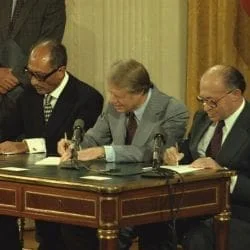
After 13 days of closed talks at Camp David, Sadat and Begin signed two frameworks, mediated by President Carter. One mapped out peace between Egypt and Israel and a withdrawal from Sinai. The other proposed self-government for Palestinians in the West Bank and Gaza Strip. The first was carried out; the second was not.
Where it stands today
Partly implemented: the Egyptian–Israeli framework became the 1979 peace treaty6. The autonomy framework for the West Bank and Gaza Strip was never implemented.
To turn the breakthrough of Sadat's visit into an agreed plan: peace between Egypt and Israel, and autonomy for the Palestinians.
The challenge
After Sadat's visit to Jerusalem, the direct talks stalled. Egypt demanded all of Sinai and did not want to be seen as abandoning the Palestinians. Israel wanted full peace and security arrangements, and found it hard to give up its settlements and airfields in Sinai.
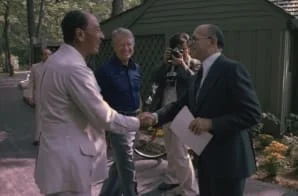
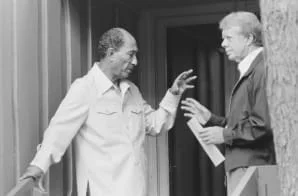
Carter invited both leaders to the presidential retreat and ran the mediation himself1.
A shared basis: Security Council Resolutions 242 and 33834.
West Bank and Gaza Strip: a transitional period of up to five years in which a self-governing authority is elected; once it is elected, the Israeli military government and civil administration withdraw3.
Final-status talks begin no later than the third year, with Egypt, Israel, Jordan and representatives of the Palestinians3.
Egypt and Israel sign a peace treaty within three months3.
Israel withdraws from Sinai in stages; limited-force zones and a UN presence are set up3.
Free passage through the Suez Canal, the Strait of Tiran and the Gulf of Aqaba3.
Choose a country on the map or in the list. Use + and − to zoom. On touch screens, enable gestures to drag and pinch; scroll the page outside the map. Keyboard: arrows to pan, + and − to zoom, Home to reset.
Layers · Legend
International boundary agreed in a peace treaty
Treaty line with Jordan, “without prejudice to the status” of the territory beyond it
1949 armistice line (“Green Line”) — not an agreed final border
“Blue Line” — UN line of withdrawal (2000), not a border
Ceasefire / disengagement line with Syria (1974)
Other international boundary
West Bank and Gaza Strip: permanent status not agreed
Golan Heights: held by Israel since 1967; annexation not recognised by the UN
UN area of separation (UNDOF)
Classification follows the original research as of 7 Oct 2026. This schematic map is not a legal boundary map or a live update.
International boundary agreed in a peace treaty
Treaty line with Jordan, “without prejudice to the status” of the territory beyond it
1949 armistice line (“Green Line”) — not an agreed final border
“Blue Line” — UN line of withdrawal (2000), not a border
Ceasefire / disengagement line with Syria (1974)
Other international boundary
West Bank and Gaza Strip: permanent status not agreed
Golan Heights: held by Israel since 1967; annexation not recognised by the UN
UN area of separation (UNDOF)
Schematic map. Lines are approximate and are not a legal determination. Data: Natural Earth (public domain), 1:10m scale; line classification and place names by this site. Lines as of October 2026. Peace map
The hard decisions
Begin agreed to put the question of the Sinai settlements to a Knesset decision. The matter was settled in an exchange of letters, and the sides argued over the letter's wording until the last moment1.
Sadat signed a framework to which the Palestinians were not a party, and without an Israeli commitment to withdraw from the West Bank or East Jerusalem. On Jerusalem, each side only recorded its position in a separate letter1.
In the Knesset, 19 members voted against the accords1.
Where accounts differ
According to Jimmy Carter
Carter understood that Begin had undertaken to freeze settlement building for longer than three months, and spoke of a misunderstanding between them5.
According to Menachem Begin
Begin said he had not agreed to a freeze of more than three months – the period set for negotiating the peace treaty with Egypt53.
What was carried out
The Egyptian–Israeli framework produced a peace treaty – after six months of negotiation, not three6.
What was not
The autonomy framework for the West Bank and Gaza Strip was not implemented: no self-governing authority was elected under it, and final-status talks did not begin.
What remains open
The idea of a five-year transitional period and Palestinian self-government returned, with changes, in the Oslo Accords 15 years later.
Photos, videos and quotes
In the spirit of the Nobel Prize tradition we gave to each other the most momentous pledge: No more war. No more bloodshed. We shall negotiate and reach agreement.
Menachem Begin · Nobel Lecture, Oslo, 10 December 1978. Begin presents the words as a pledge he and Sadat gave each other – so the wording predates the peace treaty signing ceremony. Official Nobel Foundation text, in English; consecutive sentences. The translations are the site's own, not official texts. Quote source: The Nobel Prize (Nobel Foundation)
Click to load the YouTube player, or open the source.