Room for Peace

Israel and the Palestinians ·

Oslo I – the Declaration of Principles

A declaration of principles for an interim period of up to five years — not a final peace treaty, and not an agreement between two states.

In 30 seconds

On 13 September 1993 the Declaration of Principles between Israel and the PLO was signed at the White House4. It provided for temporary Palestinian self-government, starting in the Gaza Strip and Jericho, and deferred the hard issues — Jerusalem, refugees, settlements, security and borders — to permanent-status negotiations4.

Where it stands today

The interim period was due to end on 4 May 199911, but no permanent-status agreement was reached, and the temporary arrangements built on the Declaration go on operating by default. As of October 2026, the Security Council Report survey describes no permanent-status negotiations14.

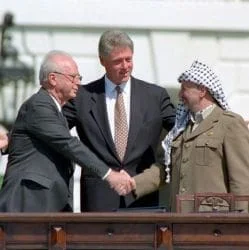
President Clinton stands between Yitzhak Rabin and Yasser Arafat as they shake hands on the White House South Lawn, 13 September 1993
President Clinton stands between Yitzhak Rabin and Yasser Arafat as they shake hands on the White House South Lawn, 13 September 1993 · Vince Musi / The White House – William J. Clinton Presidential Library, National Archives (NAID 1985480)

In one sentence

To replace confrontation between Israel and the PLO with step-by-step negotiation: temporary Palestinian self-government first, a permanent settlement after.

The challenge

The Washington talks that opened after the Madrid Conference were deadlocked by 19931. Israel and the PLO still did not recognise each other2.

Israel sought security and recognition of its right to exist; the PLO sought recognition as the representative of the Palestinian people and a start to ending Israeli control of the territories. The first attempt to bridge that gap was the letters of mutual recognition2.

The road there

  1. Towards the end of the year Terje Rød-Larsen, head of the Norwegian research institute Fafo, proposes a secret channel; the Norwegian foreign ministry backs it3.
  2. Talks open in Norway. On the Israeli side: the academics Yair Hirschfeld and Ron Pundak; for the PLO: Ahmed Qurei (Abu Ala) and Hassan Asfour3.
  3. A first draft is shown to the Israeli leadership. The talks become official, and Uri Savir and Joel Singer join them3.
  4. The Declaration is initialled in Oslo3.
  5. Letters of mutual recognition between Yasser Arafat and Yitzhak Rabin2.
  6. The signing ceremony in Washington4.

The people

What was agreed

  • An interim period of no more than five years, beginning with Israel's withdrawal from the Gaza Strip and the Jericho area4.
  • The Israeli military withdrawal from Gaza and Jericho is to be completed within four months of signing the detailed agreement on it4.
  • A Palestinian Council is to be chosen in direct, free and general elections, under agreed supervision and international observation, no later than nine months after the Declaration enters into force4.
  • Permanent-status negotiations are to begin no later than the start of the third year of the interim period4.
  • The issues deferred to permanent status: Jerusalem, refugees, settlements, security arrangements, borders, relations and cooperation with other neighbours4.
  • The Declaration entered into force one month after signing4.

Read the document

The geography

100%
Schematic map of Israel and its neighbours with line typesWest BankGaza StripJerusalemTel AvivGazaRamallahAmmanRafahNaharayim / Baqura

Choose a country on the map or in the list. Use + and − to zoom. On touch screens, enable gestures to drag and pinch; scroll the page outside the map. Keyboard: arrows to pan, + and − to zoom, Home to reset.

Layers · Legend
  • International boundary agreed in a peace treaty
  • Treaty line with Jordan, “without prejudice to the status” of the territory beyond it
  • 1949 armistice line (“Green Line”) — not an agreed final border
  • “Blue Line” — UN line of withdrawal (2000), not a border
  • Ceasefire / disengagement line with Syria (1974)
  • Other international boundary
  • West Bank and Gaza Strip: permanent status not agreed
  • Golan Heights: held by Israel since 1967; annexation not recognised by the UN
  • UN area of separation (UNDOF)

Classification follows the original research as of 7 Oct 2026. This schematic map is not a legal boundary map or a live update.

  • International boundary agreed in a peace treaty
  • Treaty line with Jordan, “without prejudice to the status” of the territory beyond it
  • 1949 armistice line (“Green Line”) — not an agreed final border
  • “Blue Line” — UN line of withdrawal (2000), not a border
  • Ceasefire / disengagement line with Syria (1974)
  • Other international boundary
  • West Bank and Gaza Strip: permanent status not agreed
  • Golan Heights: held by Israel since 1967; annexation not recognised by the UN
  • UN area of separation (UNDOF)

Schematic map. Lines are approximate and are not a legal determination. Data: Natural Earth (public domain), 1:10m scale; line classification and place names by this site. Lines as of October 2026. Peace map

The hard decisions

  • Who signed and who shook hands: the document was signed by Foreign Minister Shimon Peres for Israel and by Mahmoud Abbas for the PLO; the witnesses were US Secretary of State Warren Christopher and Russian Foreign Minister Andrei Kozyrev4. Rabin and Arafat, who led the move, took part in the ceremony hosted by President Bill Clinton and shook hands, but did not sign the Declaration.
  • The process was run in secret, in Norway, and bypassed the official talks in Washington13.
  • Opposition was fierce on both sides. In Israel, the follow-up agreement passed the Knesset in 1995 by a narrow 61 votes to 595. On the Palestinian side, Hamas rejected the negotiations and boycotted the 1996 elections6.
  • Violence accompanied the process: on 25 February 1994 worshippers were massacred at the mosque in Hebron and the talks stopped7; in February–March 1996 59 people were killed in Israel in four Hamas suicide bombings, most of them on buses and at a shopping centre8.

What was carried out

  • In May 1994 the Gaza–Jericho Agreement was signed, Israel withdrew from most of the Strip and from the Jericho area, and the Palestinian Authority was established910.
  • Elections for the Palestinian Council and for the head of the Authority were held on 20 January 1996 — well behind the nine-month target64.

What was not

  • No permanent-status agreement was reached within the five years, which ended on 4 May 199911.

What changed in real life

  • For the first time a Palestinian governing body was set up in Gaza and Jericho, and later in the West Bank cities912.

What remains open

  • This is not a final peace treaty between two states. The Declaration was signed between the State of Israel and an organisation representing a people; it creates no Palestinian state, fixes no border and declares no end to the conflict. The core issues — Jerusalem, refugees, settlements, security arrangements and borders — were explicitly deferred to permanent-status negotiations4.
  • The Palestinian scholar Khalil Shikaki argued in 2001 that the problem lay in the structure itself: an open-ended agreement during which settlement construction continued13.
  • The attempt to reach a permanent-status agreement at the Camp David summit in July 2000 ended without one10.

Photos, videos and quotes

…we say to you today in a loud and a clear voice: enough of blood and tears. Enough.

Yitzhak Rabin · Signing ceremony of the Israel–PLO Declaration of Principles, South Lawn of the White House, 13 September 1993
Official White House transcript, in English. This is the end of a long sentence in which Rabin addresses the Palestinians, and the word that follows it; the opening of the sentence is omitted and marked with an ellipsis. The translations are the site's own, not official texts.
Quote source: The White House, Office of the Press Secretary (Clinton White House archive, US National Archives)

There was a time when war was fought for lack of choice. Today it is peace that is the "no-choice" option.

Shimon Peres · Nobel Lecture, Oslo, December 1994
The English text published by the Nobel Foundation; two consecutive sentences. The lecture page shows no date; 10 December is the date of the prize ceremony. The site did not verify the language in which the lecture was delivered. The translations are the site's own, not official texts.
Quote source: The Nobel Prize (Nobel Foundation)

Ladies and gentlemen, the battle for peace is the most difficult battle of our lives.

Yasser Arafat · Signing ceremony of the Israel–PLO Declaration of Principles, South Lawn of the White House, 13 September 1993
Arafat spoke in Arabic. The text shown is the English in the official White House transcript, which does not say whether it is a translation or the interpreter's words. The Arabic shown here is the site's translation from the English, not his original words.
Quote source: The White House, Office of the Press Secretary (Clinton White House archive, US National Archives)

Peace, for us, is an asset and in our interest.

Yasser Arafat · Nobel Lecture, Oslo, December 1994
The lecture was given in Arabic. The text shown is the English translation published by the Nobel Foundation ("Translation from the Arabic text by D. Karara"). The lecture page shows no date; 10 December is the date of the prize ceremony. The Arabic shown here is the site's translation from the English, not the original text.
Quote source: The Nobel Prize (Nobel Foundation)

We have come to this point because we believe that peaceful coexistence and cooperation are the only means for reaching understanding and for realizing the hopes of the Palestinians and the Israelis.

Mahmoud Abbas · Signing ceremony of the Israel–PLO Declaration of Principles, South Lawn of the White House, 13 September 1993
The English in the official White House transcript, which does not say whether it is a translation or the interpreter's words. The site did not independently verify the language in which the remarks were delivered; the Arabic shown here is the site's translation from the English.
Quote source: The White House, Office of the Press Secretary (Clinton White House archive, US National Archives)

A peace of the brave is within our reach.

Bill Clinton · Signing ceremony of the Israel–PLO Declaration of Principles, South Lawn of the White House, 13 September 1993
Official US text (Public Papers of the Presidents), in English. The Hebrew and Arabic translations are the site's own, not official texts.
Quote source: The American Presidency Project, UC Santa Barbara (Public Papers of the Presidents)

10 December 1994 Iconic moment

Various - Arafat, Peres and Rabin Receive Nobel

Yasser Arafat, Shimon Peres and Yitzhak Rabin receive the Nobel Peace Prize, Oslo, 10 December 1994 – archive footage. The description rests on the video title.

The prize was awarded to the three jointly for their efforts to create peace in the Middle East, following the Oslo accord. The decision was contested even then, and the Oslo process never matured into a permanent agreement.

AP Archive · Opens on the source site in a new tab

13 September 1993 Iconic momentNot from an official or archival channel

Signing of the Israeli-Palestinian Declaration of Principles (1993)

Signing ceremony of the Israel–PLO Declaration of Principles, the White House, 13 September 1993 – Clinton Presidential Library channel

clintonlibrary42 · Opens on the source site in a new tab

Local photographs with credits and links to sources and licences. Where a usable image was unavailable, an archive link remains.

President Clinton stands between Yitzhak Rabin and Yasser Arafat as they shake hands on the White House South Lawn, 13 September 1993

13 September 1993

President Clinton stands between Yitzhak Rabin and Yasser Arafat as they shake hands on the White House South Lawn, 13 September 1993

Vince Musi / The White House – William J. Clinton Presidential Library, National Archives (NAID 1985480)

Licence

Public Domain, Free of Known Copyright Restrictions

See the photo in the archive

Sources

  1. Official archive U.S. Department of State, Office of the Historian
    The Madrid Conference, 1991
  2. Primary United Nations Peacemaker · 9 September 1993
    Israel–PLO Mutual Recognition, Letters and Speeches
  3. Official archive Government of Norway (regjeringen.no)
    Norway's involvement in the peace process in the Middle East
  4. Primary PA-X Peace Agreements Database, University of Edinburgh · 13 September 1993
    Declaration of Principles on Interim Self-Government Arrangements ('Oslo Accords')
  5. Primary United Nations, Division for Palestinian Rights (UNISPAL) · 31 October 1995
    Chronological Review of Events Relating to the Question of Palestine, October 1995
  6. Reference Wikipedia
    1996 Palestinian general election
  7. Primary United Nations, Division for Palestinian Rights (UNISPAL) · October 1994
    Developments related to the Middle East peace process, April–September 1994
  8. Press Jewish Telegraphic Agency (JTA) · 31 July 1997
    List of suicide bombings in Israel since the 1993 accords
  9. Research Economic Cooperation Foundation (ECF)
    Cairo Agreement on Gaza and Jericho (1994)
  10. Official archive U.S. Department of State, Office of the Historian
    The Oslo Accords and the Arab-Israeli Peace Process
  11. Primary United Nations, Division for Palestinian Rights (UNISPAL)
    Middle East peace process documents, 1998–1999 (Wye River and Sharm el-Sheikh memoranda)
  12. Reference נשים עושות שלום
    הסכמים מדיניים עיקריים במזרח התיכון
  13. Research Palestine-Israel Journal · 2001
    Taking Stock: Looking at the Past, Searching for the Future (round-table), vol. 8 no. 3
  14. Research Security Council Report · 1 October 2026
    The Middle East, including the Palestinian Question — October 2026 Monthly Forecast

Further reading