Room for Peace

Israel and the Palestinians ·

The Trump plan ("Peace to Prosperity")

A US proposal for a permanent settlement — not an agreement: it was drawn up and presented without the Palestinians, and they rejected it.

In 30 seconds

In January 2020 President Donald Trump, alongside Benjamin Netanyahu, presented a plan for permanent status. It proposed Israeli sovereignty over about 30% of the West Bank and a demilitarised Palestinian state, subject to conditions. The Palestinians had no part in it and rejected it, and it was not implemented.

Where it stands today

The plan was not adopted and not implemented: Mahmoud Abbas rejected it outright1, and the declaration of sovereignty planned in its wake was suspended in August 20202. The US plan for Gaza of 2025 is a different document; see the Gaza ceasefire3.

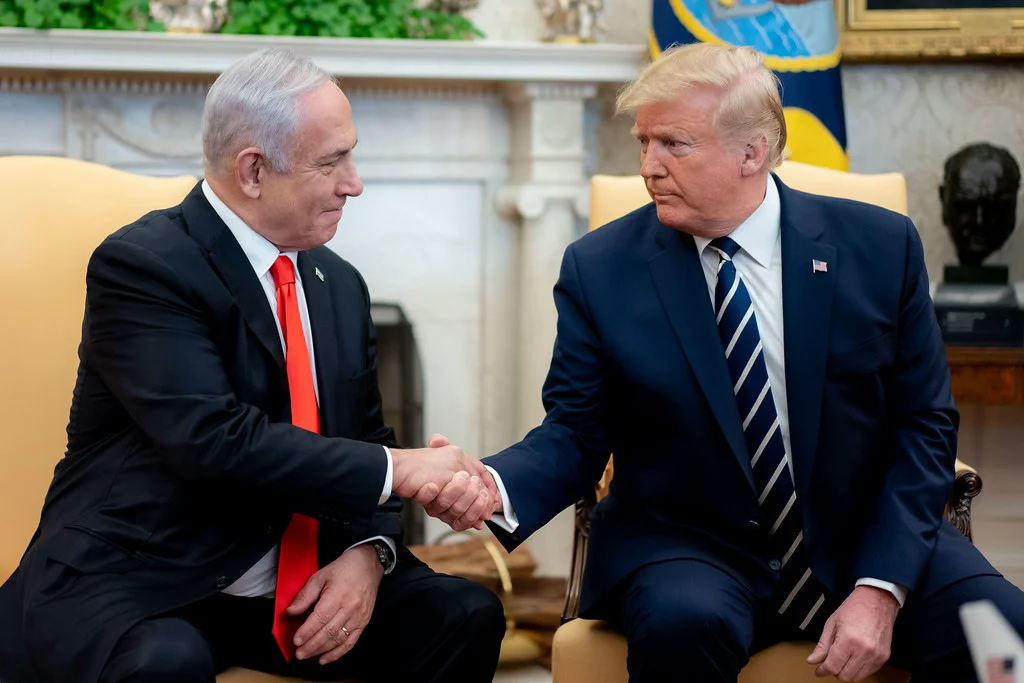
Netanyahu in a meeting with President Trump and Vice President Pence in the Oval Office
Netanyahu in a meeting with President Trump and Vice President Pence in the Oval Office · Official White House Photo by D. Myles Cullen

In one sentence

To set out a US outline for permanent status: Israeli sovereignty over a large part of the West Bank and a demilitarised, conditional Palestinian state in the rest.

The challenge

Since the collapse of the Kerry talks in 2014 there had been no permanent-status negotiations. The US administration drew up the plan without Palestinian participation and presented it before an Israeli election in March 2020, with the support of Netanyahu and his rival Benny Gantz1.

The road there

  1. Donald Trump presents the plan at the White House, alongside Benjamin Netanyahu1.
  2. A joint statement by the United States, Israel and the United Arab Emirates says Israel will suspend declaring sovereignty over the areas outlined in the plan2.

The people

Proposed
Donald Trump

What was proposed

  • Israeli sovereignty over about 30% of the West Bank, including the settlements and most of the Jordan Valley1.
  • A Palestinian state in the remaining territory, in non-contiguous areas connected by roads, bridges and tunnels1.
  • Nearly all of Jerusalem to remain with Israel; a Palestinian capital in Abu Dis, on the edge of East Jerusalem beyond the security barrier. The status quo at the Temple Mount / Haram al-Sharif to be kept1.
  • The Palestinian state would be demilitarised and would come into being only if conditions were met, among them disarming Hamas and recognising Israel as the nation state of the Jewish people; the Palestinians were given four years to meet them1.
  • Palestinian refugees: internationally funded compensation and resettlement in the West Bank, Gaza and third countries — with no return to Israel1.

The geography

100%
Schematic map of Israel and its neighbours with line typesWest BankGaza StripJerusalemTel AvivGazaRamallahAmmanRafahNaharayim / Baqura

Choose a country on the map or in the list. Use + and − to zoom. On touch screens, enable gestures to drag and pinch; scroll the page outside the map. Keyboard: arrows to pan, + and − to zoom, Home to reset.

Layers · Legend
  • International boundary agreed in a peace treaty
  • Treaty line with Jordan, “without prejudice to the status” of the territory beyond it
  • 1949 armistice line (“Green Line”) — not an agreed final border
  • “Blue Line” — UN line of withdrawal (2000), not a border
  • Ceasefire / disengagement line with Syria (1974)
  • Other international boundary
  • West Bank and Gaza Strip: permanent status not agreed
  • Golan Heights: held by Israel since 1967; annexation not recognised by the UN
  • UN area of separation (UNDOF)

Classification follows the original research as of 7 Oct 2026. This schematic map is not a legal boundary map or a live update.

  • International boundary agreed in a peace treaty
  • Treaty line with Jordan, “without prejudice to the status” of the territory beyond it
  • 1949 armistice line (“Green Line”) — not an agreed final border
  • “Blue Line” — UN line of withdrawal (2000), not a border
  • Ceasefire / disengagement line with Syria (1974)
  • Other international boundary
  • West Bank and Gaza Strip: permanent status not agreed
  • Golan Heights: held by Israel since 1967; annexation not recognised by the UN
  • UN area of separation (UNDOF)

Schematic map. Lines are approximate and are not a legal determination. Data: Natural Earth (public domain), 1:10m scale; line classification and place names by this site. Lines as of October 2026. Peace map

The hard decisions

  • The Palestinians took no part in drawing up the plan; Mahmoud Abbas rejected it outright1.
  • Immediately after it was presented, Netanyahu announced that his government would begin proceedings to apply sovereignty to the settlements and the Jordan Valley1.

What was carried out

—

What was not

  • The plan did not become an agreement, and no Palestinian state was established on its terms1.
  • Sovereignty was not applied: it was suspended in the statement that announced normalisation between Israel and the United Arab Emirates, on the way to the Abraham Accords. The wording speaks of suspension, not cancellation2.

What remains open

  • A plan drawn up with only one side did not produce negotiations: the side that was absent from it rejected it1.

Photos, videos and quotes

Local photographs with credits and links to sources and licences. Where a usable image was unavailable, an archive link remains.

Netanyahu in a meeting with President Trump and Vice President Pence in the Oval Office

27 January 2020

Netanyahu in a meeting with President Trump and Vice President Pence in the Oval Office

Official White House Photo by D. Myles Cullen

Licence

Public Domain

See the photo in the archive
Trump and Netanyahu at the East Room presentation of the US plan, January 2020 – a proposal, not an agreement

28 January 2020

Trump and Netanyahu at the East Room presentation of the US plan, January 2020 – a proposal, not an agreement

Official White House Photo by Shealah Craighead

Licence

Public Domain

See the photo in the archive

Sources

  1. Research Congressional Research Service · 2020
    Israel and the Palestinians: U.S. Peace Plan and Possible Israeli Annexation (IN11214)
  2. Primary The American Presidency Project, UC Santa Barbara · 13 August 2020
    Joint Statement of the United States, the State of Israel, and the United Arab Emirates
  3. Primary United Nations (UNISPAL) · 17 November 2025
    Security Council resolution 2803 (2025) and the annexed Comprehensive Plan to End the Gaza Conflict